A First-Timer's Guide to St. John: What I Wish I'd Known
St. John has a way of catching first-time visitors unprepared — not because the logistics are complicated, but because they're different from what most travelers expect. There's no airport. Driving is on the left. A significant portion of the island has no cell service. And the beach parking lots fill before 10am.
This guide covers what first-time visitors to St. John consistently overlook — the practical layer beneath the trip-planning surface. Not what to do, but what to know before you arrive.
Cruz Bay waterfront and ferry dock panorama, St. John USVI, with sailboats and green hillsides
Cruz Bay — the ferry dock is where every visit to St. John begins
St. John has no airport. Every visitor arrives by boat, which means your trip planning starts on a neighboring island. The most common route is to fly into Cyril E. King Airport (STT) on St. Thomas, then take a 20-minute ferry from Red Hook on St. Thomas's east end to Cruz Bay on St. John.
The Red Hook to Cruz Bay ferry runs approximately every hour from early morning until midnight. The adult one-way fare is $13 [VERIFY current fare], plus $4 per bag. It's a short crossing, but the logistics of getting from STT to Red Hook take longer than most people plan for — budget 45 minutes to an hour for the taxi or rental car ride across St. Thomas, depending on traffic.
An alternative ferry from Charlotte Amalie (downtown St. Thomas) runs a few times daily and takes about 45 minutes — longer but useful if you're staying near downtown St. Thomas before crossing. For a complete breakdown of ferry routes, schedules, and timing, see our guide on how to get to St. John.
One thing that matters more than first-timers expect: if you're renting a car on St. John rather than bringing one from St. Thomas, you'll arrive in Cruz Bay as a foot passenger and pick up your rental there. If you want to bring a vehicle from St. Thomas, take a car barge instead. This separate ferry costs around $50 one-way and is operated by companies including Love City Car Ferries and the Big Red Barge Company. Most visitors find it simpler and cheaper to arrange a rental on St. John directly.
The USVI follows British-style road rules: traffic moves on the left side of the road. The vehicles here are American, with the steering wheel on the left side of the car, which means you're steering from the lane closest to the road's center. Most drivers adapt within a day, but the first hour, especially on St. John's narrow, winding roads, requires full attention.
Roads here are steep and tight. Some turn to unpaved gravel before reaching a beach parking lot or trailhead. A high-clearance vehicle (a Jeep Wrangler or comparable SUV) handles the terrain better than a standard car. The gradient on sections of Centerline Road and the south shore routes is significant. Give yourself room.
Book Your Rental Car Before You Book Your Flight
Car inventory on St. John is genuinely limited. During high season (roughly mid-November through April), vehicles book out weeks in advance. Arriving without a reservation and hoping to find an available Jeep in Cruz Bay is a plan that fails more often than it works.
The rental companies operating on St. John include Cool Breeze, L&L Jeep Rental, Cruz Bay Car Rental, and a few others. They maintain small fleets. Book early.
Renters must be at least 25 years old with a valid U.S. driver's license. Foreign nationals are typically required to purchase a temporary USVI license for $30. For more detail on operators, rates, and what to expect on the road, see our guide to getting around St. John.
Most of the Island Is a National Park
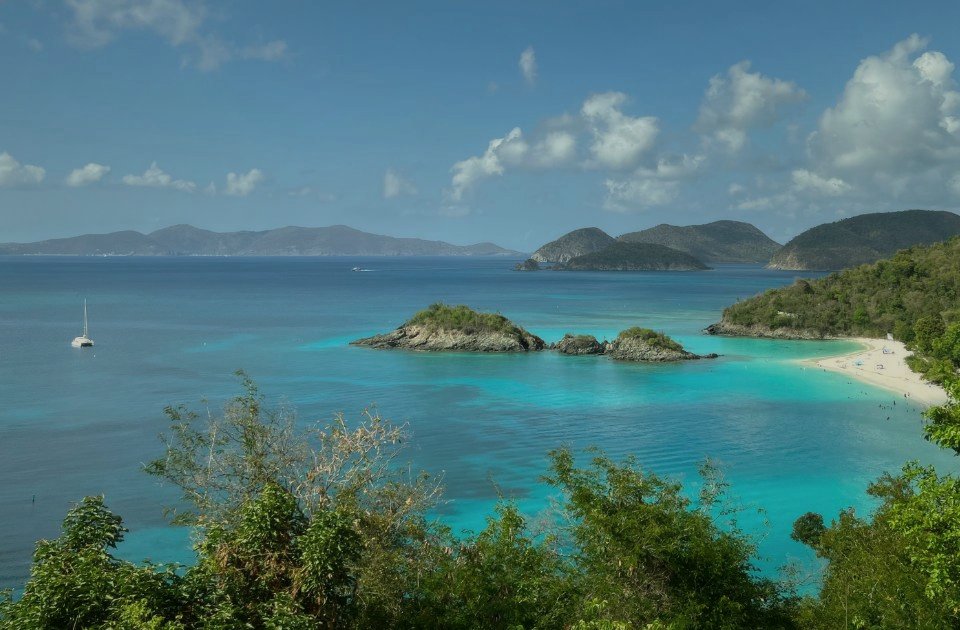
Trunk Bay — the undeveloped hillside is the result of national park protection, not luck
About 7,000 of St. John's roughly 12,500 acres are protected as part of Virgin Islands National Park — more than half the island has no commercial development. This shapes the experience in ways that first-timers don't always anticipate.
Trunk Bay, Maho Bay, Cinnamon Bay, and Hawksnest are all inside the national park boundary. That means no beach bars, no towel rentals, limited or no food service (Trunk Bay has a snack bar; most others have nothing), and parking that fills early and stays full. It also means no resort sprawl, no lounge chairs for rent. The beaches are genuinely uncrowded by the standards of most Caribbean destinations — but the facilities are minimal. Bring everything you need.
The tradeoff is worth understanding before you arrive: St. John's beaches have the character they do because of the national park designation. The undeveloped hillsides behind Trunk Bay and Cinnamon Bay aren't an oversight — they're the point. If you want a beach attendant and a frozen drink delivered to your chair, St. John is not the right island. If you want a beach that looks largely as it did fifty years ago, it's exactly right.
For a full overview of St. John's beaches, including north shore, south shore, calm water, and snorkeling options, see our guide to St. John's beaches.
Parking at North Shore Beaches Fills by 10am
In high season, the parking situation at St. John's north shore beaches is one of the more predictable frustrations. Trunk Bay's lot fills between 9am and 10am on busy days — sometimes earlier. Maho Bay has more flexibility but still gets crowded by late morning.
The fix is straightforward: arrive early. At a north shore beach by 8:30am, parking is rarely a problem. After 10am, you may spend 20 minutes waiting, or have to come back. The National Park Visitor Center in Cruz Bay runs a shuttle to certain beaches during peak season — worth checking if early starts aren't part of your plan.
Reef-Safe Sunscreen Is the Law, Not a Suggestion
The U.S. Virgin Islands was the first jurisdiction in the United States to ban chemical sunscreens harmful to coral reefs. Since March 2020, products containing oxybenzone, octinoxate, or octocrylene have been prohibited throughout the territory — including in pools, not just at the beach. First-time violations carry a $1,000 fine.
This matters practically because a significant portion of sunscreen sold at mainland pharmacies contains at least one of the banned compounds. Bring reef-safe sunscreen from home (brands using zinc oxide or titanium dioxide as the active ingredient are compliant) or plan to buy locally. Starfish Market in Cruz Bay carries options, but selection is limited and island prices are higher than on the mainland.
What Cruz Bay Has and What It Doesn't
Cruz Bay is the main port of entry and the closest thing St. John has to a town center. It has restaurants, a handful of bars, some small shops, and the ferry dock. It does not have a large grocery store, a pharmacy with extensive inventory, or much of the commercial infrastructure mainland visitors take for granted.
The main grocery option is Starfish Market, located at The Marketplace shopping center on Route 104 — about a 5-minute drive or a 15-minute walk from the ferry dock. It's well-stocked by island standards, with fresh produce, meat, and pantry staples, open daily from approximately 7:30am to 8pm. Expect prices to run noticeably higher than what you'd pay at home; much of the inventory is shipped in. Dolphin Market in Cruz Bay is smaller, useful for quick stops.
If you're staying in a villa with a full kitchen, doing a proper shop your first afternoon saves logistics for the rest of the trip. For a deeper look at what's worth your time in Cruz Bay and what to skip, see our guide to Cruz Bay.
You'll Want More Time Than You Think
Many first-timers initially assume a long weekend is enough for St. John. It rarely is. The beaches require time to reach and time to sit with. The hiking trails, more than three dozen inside the national park, are worth more than a single morning. The pace of the island itself takes a day or two to settle into before it starts to feel like a real break.
Five nights is the minimum stay at Indo House, and it reflects real experience: by night three, most guests feel like they're finally arrived. Timing for St. John depends on your priorities — high season (December through April) brings dry weather and reliable conditions but the most visitors; late April through early June offers similar weather with better availability and lower rates.
Where You Stay Shapes the Whole Trip
Indo House — four bedrooms, private waterfront, south shore location
Accommodation decisions on St. John carry more weight than on most islands because there's no central hotel district and distances matter. The north shore puts you closer to Trunk Bay, Maho Bay, and the main hiking trailheads, but it's a longer drive to Cruz Bay for provisions and dining. The south shore, where Indo House sits in Great Cruz Bay, offers a quieter base with direct water access, a 10-minute drive to Cruz Bay, and a different quality of morning than the busier north shore.
For groups and families, a private villa changes the geometry of the trip: meals in, early mornings without logistics, no shared pools or lobby traffic. Indo House accommodates up to eight guests across four bedrooms, with waterfront access, a private concierge, and a setting that makes the quiet parts of St. John feel like the point.
No. St. John is part of the U.S. Virgin Islands, a U.S. territory, so American citizens can travel there with a valid government-issued ID. A driver's license is sufficient. A passport is not required for domestic travelers. International visitors follow standard U.S. entry requirements.
How do I get from the airport to St. John?
Fly into Cyril E. King Airport (STT) on St. Thomas. From there, take a taxi or rental car approximately 45 minutes east to Red Hook, then board the passenger ferry to Cruz Bay. The crossing takes about 20 minutes and runs roughly every hour from early morning until midnight. Budget at least 90 minutes from STT to arriving in Cruz Bay under normal conditions.
Do I need to rent a car on St. John?
For most visitors, yes. Taxis serve the main routes and work for a short trip centered on Cruz Bay and a few nearby beaches, but having a vehicle gives you flexibility that matters on an island with limited public transit. Book well ahead — rental inventory is small and books out quickly in high season.
Is St. John good for first-time Caribbean travelers?
It's one of the more accessible Caribbean destinations for first-timers because the U.S. dollar is the currency, English is spoken everywhere, no passport is required for Americans, and the infrastructure is reliable. The main adjustment is left-side driving and the ferry logistics. The absence of all-inclusive resorts means you need to plan provisions and meals more than you might elsewhere.
When is the right time for a first visit to St. John?
January through March brings dry weather and clear visibility, but also the most visitors and highest rates. Late April through early June offers comparable conditions with fewer crowds and better availability. Hurricane season runs June through November, with the highest risk in August and September — many experienced visitors still travel in these months, but it's worth understanding the tradeoff.
Related reading
More from the Journal
Thoughtful guides and perspectives from St. John, written to help you plan with clarity and arrive more at ease.